

 Learn About the Canyon Diablo Meteorite

Basic Information
- Location: Coconino County, Arizona, about 40 miles east of Flagstaff, Arizona. Latitude 35 degrees 3 minutes North, Longitude 111 degrees 2 minutes West.
- Structural Class: Coarse octahedrite, Og, Widmanstatten bandwidth 2.0 ±0.5mm.
- Chemical Class: Group I, 7.1% Ni, 0.46% Co, 0.26% P, about 1% C, about 1% S, 80 ppm Ga, 320 ppm Ge, 1.9 ppm Ir.
- Time of Fall: Between 20,000 and 40,000 years ago.
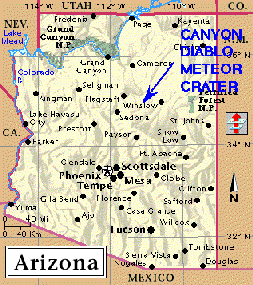
Location Map
Here is a map showing where the Canyon Diablo Meteor Crater is located:History
The Canyon Diablo crater, and quite likely its iron meterorites, were known to the Indians before the white man came to Arizona. While it has been reported that the area was considered cursed, the fall was almost certainly prior to Indian habitation. There is no reason to believe that the Indians knew of the extraterrestrial origin of the crater.
The first specimen was brought to the attention of scientists in the mid 1800s. Meteorite dealers began to trade in Canyon Diablo samples in the 1890s. Large quantities of specimens were reportedly shipped to location throughout the world during those early years.
While the meteorites were gaining recognition, the origin of the crater remained in doubt. G.K Gilbert, an eminent geologist of the time and the first to suggest meteoritic origin of lunar craters, concluded that the Canyon Diablo crater was the result of a steam explosion. This theory was a long time dying and was accepted by some as late as 1953.
Commercial interests were not so doubtful. In 1903, lawyer-mining engineer-geologist Daniel Barringer recognized the crater as a potential site for mining of iron and nickel. Barringer staked mining claims on the site and began a search for a huge iron mass.
Over the next twenty years Barringer spent more than $600,000 drilling dozens of drill holes in the crater floor looking for the large mass. When he did not find it there, he hypothesized that it might be buried under the south rim. A final hole did strike increasing metal before it had to be abandoned because of bad drilling conditions. Some claimed that the long sought mass had been discovered.
Even before Barringer began his final holes a controversy began on whether any large mass would ever be found. In 1908, George Merrill suggested that the meteorite may have vaporized on impact.
Barringer died in 1929 and the high cost and ambiguous results of Barringer's efforts led investors in his company to seek reexamination of the premise of a large buried mass. The company retained a well respected astronomer and ballistics expert, F.R. Moulton, to make calculations about the mass of iron that could be expected. Moulton's startling conclusion was that the high energy of the impact would vaporize and fragment the entire mass--there would be no large iron-nickel mass.
Eventually, students of the matter reached a consensus that indeed the mass had been mostly vaporized on impact. Drilling and geophysical studies supported this conclusion. In addition, Nininger found a large area of tiny spherical iron droplets north east of the crater.
Today the Crater is operated as a private tourist attraction by the Meteor Crater Enterprise. The crater itself still belongs to the Barringer family.
The Impact and the Crater
The Meteor Crater is a huge hole--about three quarters of a mile wide and 600 feet deep. So, what kind of a meteorite could have made this hole? How heavy was it? How fast was it traveling? These questions have been the subject of scientific speculation since the crater was first recognized being the result of an impact. From 1910 to the 1950s different scientists estimated a mass varying between 5,000 and 5,000,000 tons. In 1963, a scientist compared the crater to those made by nuclear tests. He calculated that an energy of 1.7 megatons (1.7 million tons of TNT) would be required to produce the crater. This energy would be delivered by a mass of 63,000 tons (a sphere about 80 feet in diameter) traveling at 9 miles per second.
 The resulting crater is 3400 feet across, is about 600 feet from rim to floor, and has a rim that rises 200 feet above the plain. From the air, the crater has a squarish shape. The speculation is that this results from the character of the preexisting rock formations. (Crater photo courtesy Calvin Hamilton.).
Click here to see a really big picture of the Canyon Diablo Crater. Click here to find more information on craters and links to other sites.
Where Did the Meteorite Go?
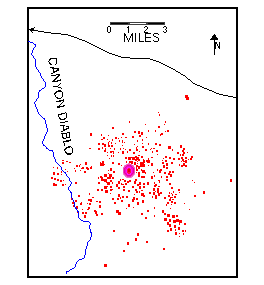 If a 63,000 ton meteorite hit the earth in Arizona, where is it now? As was noted above, Moulton calculated that most of the mass would have been vaporized on impact. Harvey Nininger, a famous meteorite hunter and well-respected student of meteorites, hypothesized that he would find evidence of iron condensed after vaporization. He studied the area around the crater and mapped a large are to the northeast of the crater were tiny spherical droplets of condensed iron can be found. This is apparently where most of the mass is located.
The idea that the huge Canyon Diablo mass was blasted into small bits is supported by the lack of large specimens. The largest Canyon Diablo recovered is the 639 Kg on display in the Meteor Crater Museum. Specimens over ten kilograms are rare and those over 100 Kg are only a handful. The adjoining map gives a rough idea of the distribution of the small specimens around the crater.
Nininger estimated that about 30 tons of specimens had been collected. Other workers have estimated that 8,000 tons of iron are contained in the fine grained material around the crater. This leaves about 55,000 tons to speculate about. Some of it remains buried as Barringer's drilling showed. The largest part of it may have been vaporized and drifted far away. Some of it remains in the form of specimens in area surrounding the crater. Until the area was closed to meteorite hunting recently, hunters with metal detectors were still finding significant numbers of specimens.
Minerals of the Canyon Diablo
The mineralogy of Canyon Diablo meteorites depends on whether they have been shocked by impact. While all of the specimens were shocked to some degree, some specimens found around the crater rim show very different mineralogy.The less altered mineralogy is typical of iron meteorites. The important minerals are:
- Kamacite--this iron nickel alloy makes about 90 percent of specimens.
- Taenite--the other iron nickel constituents taentie and plessite make up 1 to 4 percent of the material.
- Schreibersite crystals occur as skeletal blades. This is a very hard mineral that will ruin a saw blade unfortunate enough to be put to the task of cutting a Canyon Diablo.
- Troilite--this iron sulfide occurs as nodules up to 50 mm across or as elongated lenses. Troilite may be mixed with graphite, daubreelite, chromite, or base metal sulfides. Troilite-graphite masses may make up about 8.5 % of specimens.
- Graphite occurs as large bodies within iron or in separate masses.
- Cohenite, an iron carbide, is common. This mineral is even harder than Schreibersite.
- Haxonite, chromite and silicates are also found.
The specimens that were subjected to greater shock show partial melting, recrystallization, neumann banding and other deformation. Perhaps the most well-known shock effect is the transformation of graphite to diamond and lonsdaleite. These take the from of tiny dark masses that become evident on sawing. A diamond blade will move aside when it hits one of these.
Further Reading
Rocks from Space by O. Richard Norton, Mountain Press, 1994. Norton devotes a chapter to the Canyon Diablo. Both the text and pictures are excellent.
Handbook of Iron Meteorites by Vagn Buchwald, U. of California Press, 1976. This reference is very complete technical description of known iron meteorites. Buchwald takes more of a metallurgists approach to the subject.
Guidebook to the Geology of Barringer Meteorite Crater, Arizona (a.k.a. Meteor Crater)
by David A. Kring ©2007, Lunar and Planetary Institute
LPI Contribution No. 1355. This is a complete book free online.
To see our meteorite classification table and learn about the types of meteorites, click here.
Back to the Canyon Diablo Meteorites for Sale page.
 Back
to The Meteorite Market home page.
Back
to The Meteorite Market home page.