

 Tafassasset CR/Achondrite Meteorites for Sale

Location: Mali,undisclosed location until 2005 February 14. (I am unaware of the release.)
Found: 2000
Type: CR like or CR anomalous, carbonaceous chondrite or primitive achondrite possibly related to brachinites. (See discussion below.)
Description: Twenty-six pieces with a total weight of ~110 kg were found by Bernard Dejonghe on an ancient alluvial plain. The two largest weigh ~30 kg each. Twenty stones were found on a trip in early 2000, and six more in 2001 March. The geographic coordinates of these meteorites are being withheld by the finder for three years. Classification (M. Bourot-Denise, MNHNP): Fa29.3, pyroxene Fs24.3; ~30 vol% millimeter-sized relic chondrules are clearly visible in backscattered electron images. Textures and relative abundances of the phases vary considerably. The dominant lithology has a coarse grain size. It consists of olivine (poikilitically enclosed within pyroxenes in the relic chondrules), a small amount of plagioclase, 10% metal in rounded or oval-shaped grains often edged by chromite, and minor sulphides in small grains. The interchondrule matrix consists of subhedral crystals of olivine embedded in plagioclase and within anhedral crystals of chromite and phosphate that are up to 1 mm in size. Two distinct plagioclase compositions are present: An46.4Or2.2 in the matrix and An26.6Or5.2 in chondrule relics. A second lithology is finer grained and porous, without large metal grains but with fairly abundant sulphide grains. The large metal grains are composed of kamacite (6% Ni, 0.6% Co) and martensite (12% Ni, 0.4% Co). Some smaller metal grains associated with sulphides are made up of taenite (up to 36% Ni, 0.2% Co) with martensite cores. The sulphide is troilite (Cr 0.02–0.08%), with some grains containing inclusions of Cu-bearing pentlandite. See also Bourot-Denise et al. (2002). Bulk chemistry (J. Zipfel and B. Spettel, MPI; H. Palme, Köln): refractory lithophiles fractionated compared to a typical CR composition, leading to possible classification as a primitive achondrite (Zipfel et al., 2002). Oxygen isotopes (M. Javoy, IPGP): δ17O = +0.18 ± 0.08‰, δ18O = +2.94 ± 0.2‰. Weathering grade, W0/1; shock stage, unknown. Specimens: type specimen, 396 g plus five polished sections, MNHNP; main mass partly left in Niger, partly with the finder.
A 3.61 kg stone, labeled "Te-1", was found in 2000 March, probably on the same expedition noted above, and is reported by J. Otto (Frei) to have been found in the Tenere Desert at 20°45.8' N, 10°26.5' E. Classification (J. Otto and A. Ruh, Frei): a primitive achondrite; partly covered with black fusion crust; shows a recrystallization texture with abundant 120° triple junctions dominated by olivine (56 vol%, 100–700 µm, Fa28.7, 0.06 wt% CaO) and poikilitic orthopyroxene (23 vol%, up to 3 mm, Fs25.4Wo3.6) with exsolved clinopyroxene (Fs12.7Wo39.7); Fe-Ni metal is irregulary distributed (~10 vol%, up to 5 mm); poikilitic plagioclase occurs in interstices (6.5 vol%, An38.5Or3.7); troilite (~3.5 vol%, 0.01 wt% Ni); chromite (~1 vol%, Fe/(Fe + Mg) = 0.817, Cr/(Cr + Al) = 0.818). Oxygen isotopes (R. Clayton and T. Mayeda, UChi): δ17O = –0.85‰, δ18O = +1.70‰, different from other achondrites. Noble gases (L. Schultz, MPI): data compatible with those of brachinites; exposure age is ~45 Ma. Shock stage, S1/2; weathering grade, W0. From Meteoritical Bulletin 86.
Link to Meteoritical Bulletin Database.
 Click on the photo to see a larger photo. Click here to put your selection
on our order form. Click here for more information or photos.
Click on the photo to see a larger photo. Click here to put your selection
on our order form. Click here for more information or photos.
 |
 |
 |
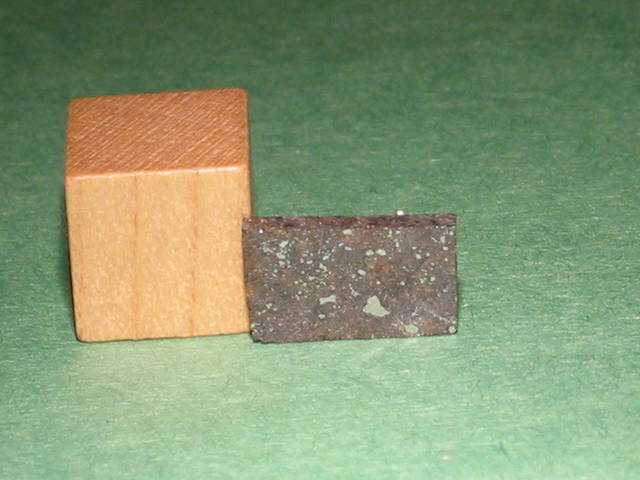
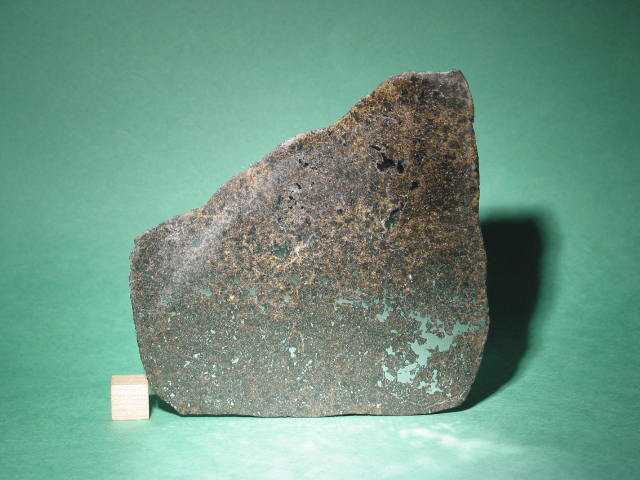
| #TAF-378 | #TAF81-0 | About Scale: Each photo has a small one centimeter cube. That's a little less than a half inch on a side. The coin above is a US dime. |
| Weight: 0.378gm | Weight: 81-0 gm | |
| Features: Part slice | Features: Part slice | |
| Price: sold | Price: sold |
 Back
to The Meteorite Market home page.
Back
to The Meteorite Market home page.